Compact, physics-aligned
modeling tools.
We build small, sharp prototypes that sit between full-fat simulation and real-world hardware: accelerating tolerance / yield analysis, exploring chi/u-style environment twins, and testing whether new frameworks (like our s–d lens) actually buy a measurable reduction in heavy compute.
At the moment we are focused on maintaining prior R&D probes and evaluating where the next meaningful 10× improvement opportunity lies.
R&D Probes
R&D PROBE · COMPLETEDC³-Photonics
Arrived here from c3photonics.com? C³-Photonics is an internal Determiq R&D probe, not an active product.
A small “coupler yield & tolerance assistant” prototype. The goal was to see whether a chi/u-style environment parameterization could compress the simulation workload for edge / adiabatic couplers compared to brute-force geometry + Monte Carlo.
What we actually built:
- A Meep-backed taper runner (2D FDTD, TE, edge-coupler family) on local machines and AWS.
- A surrogate model fitted to Meep IL data on a 4×4 grid of geometries and environment points.
- A chi/u-style toy benchmark comparing baseline geometry + Monte Carlo sampling against an environment-axis–compressed flow.
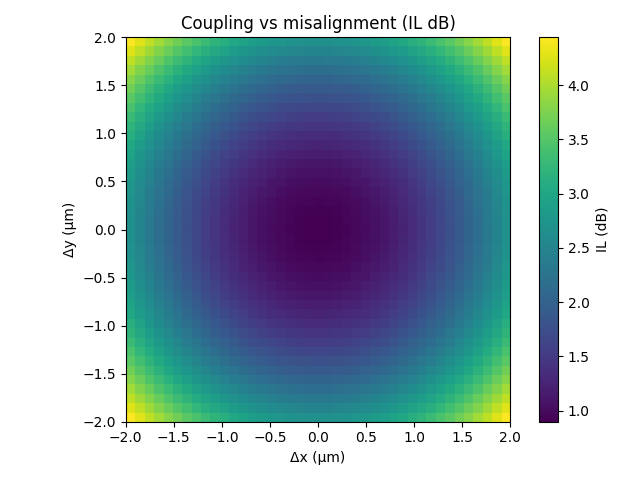
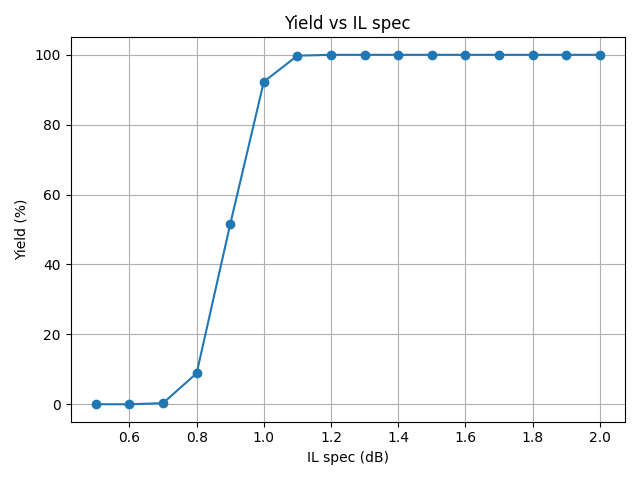
On this Meep-calibrated taper family (using a 4×4 grid as the “physics oracle”), the chi/u-style flow matched the baseline “best” geometry and toy yield estimate for an IL ≤ 1 dB spec while using 62.5× fewer effective heavy EM solves (8000 → 128). On the same dataset, Meep runtimes have a median of 376.8 s per run (≈ 6.3 minutes), while the calibrated surrogate evaluates in ~6 µs per call (10,000 calls in ≈ 0.062 s), so a single median Meep run corresponds to ≈ 60 million surrogate queries. In wall-clock terms, the naive Monte Carlo-style tolerance/yield study is “weeks of EM,” whereas the chi/u pipeline looks more like “hours of EM + milliseconds of surrogate scans.” This remains a toy but concrete, reproducible benchmark, not a claim against commercial state-of-the-art tools.
STATUS
C³-Photonics is kept as an internal R&D probe rather than a packaged product. The Meep-backed benchmark and surrogate pipeline are in a stable enough state to reproduce the current toy results on demand. We’re open to conversations and joint validation on real coupler or tolerance / yield workflows, especially where chi/u-style environment compression might offer a clear advantage over off-the-shelf methods.
Example CLI mockup used during design — not a released tool.
Ay: ±0.8 µm (demo)
Yield est: ~94% (demo)
Example Outputs (from the C³-Photonics probe)